
Azure Chargeback Architecture: The Two Models That Actually Work
2025-12-23 · ~9 min read
Azure chargeback requires architecture-first design: subscription-per-application (clean isolation) or subscription-per-department (tag discipline required). Tags alone won't fix bad architecture. True chargeback happens in your ERP, not Azure Cost Management.
What's the foundation for Azure chargeback that actually works?
Short Answer: Azure chargeback requires either subscription-per-application (clean cost isolation) or subscription-per-department (strict tag discipline required). Tags alone won't fix bad subscription architecture. True chargeback happens in your ERP system, not Azure Cost Management—Azure only provides cost visibility and allocation rules, not internal invoicing or money movement between departments.
Why most Azure chargeback implementations fail
If you've ever tried to implement internal chargeback in Microsoft Azure—billing departments, teams, or applications for their actual cloud usage—you've probably felt the frustration.
Azure Cost Management gives you:
- Visibility
- Tags
- Reports
- Budgets
- Cost allocation rules
But what it does not give you is actual chargeback.
There is no internal invoicing engine. There is no money movement. There is no automated debit/credit between departments.
True chargeback always happens outside Azure, inside ERP, GL, or financial systems.
And that's where most teams get it wrong.
They jump straight to: "Let's fix tags."
Tags help—but they are not the foundation.
The real foundation is architecture.
Specifically: how you structure subscriptions.
Microsoft quietly documents this in the Cloud Adoption Framework and landing zone guidance, but it's rarely stated clearly:
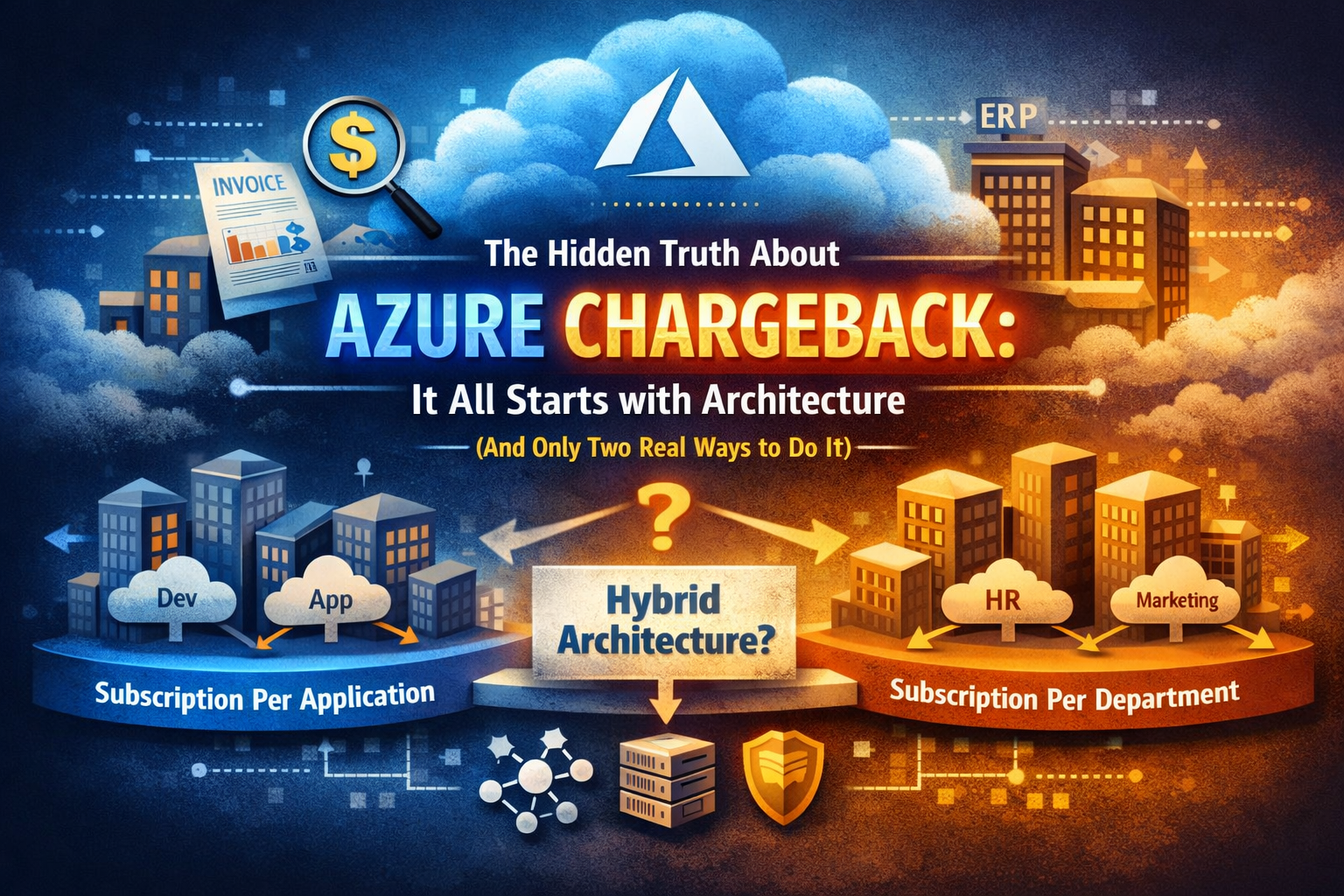
There are only two primary Azure architectures that reliably support chargeback.
Everything else is a variation—or a mess.
The Two Chargeback Architectures That Work
1️⃣ Subscription per Application (Workload-Aligned)
Each major application or workload gets its own dedicated subscription—often split further into dev/test/prod.
Why this works for chargeback:
Costs are naturally isolated at the subscription boundary.
You don't need complex tag logic just to answer: "How much did App X cost this month?"
Best for:
- Application-level accountability
- Teams with full ownership of a workload lifecycle
- Regulated or isolation-heavy environments
Pros:
- Clean, defensible cost reporting
- Simple budgets and alerts per app
- Minimal cross-contamination
- Easy integration with finance systems
Cons:
- Subscription sprawl
- Management overhead
- Reservations and Savings Plans don't pool as efficiently
Microsoft alignment:
This directly maps to Application Landing Zones in the Microsoft Cloud Adoption Framework and the concept of subscription democratization.
2️⃣ Subscription per Owner (Department or Business Unit)
Subscriptions are aligned to organizational ownership—finance, marketing, engineering—while multiple apps live inside each one.
Why this works for chargeback:
It mirrors how finance already thinks: "What did Marketing spend?"
Best for:
- Department-level billing
- Centralized governance
- Maximizing reservation and Savings Plan efficiency
Pros:
- Fewer subscriptions
- Better discount pooling
- Cleaner EA/MCA billing alignment
Cons:
- 100% tag discipline required
- Untagged resources = unallocatable spend
- Requires Azure Policy enforcement
Microsoft alignment:
Common in Enterprise Agreement and Microsoft Customer Agreement setups, using billing profiles and departments.
What most enterprises actually do (Hybrid Reality)
In practice, mature organizations converge on:
Department-aligned subscriptions for broad ownership
Tags + resource groups for app-level detail
Dedicated platform subscriptions for:
- Networking
- Identity
- Security
- Shared services
Shared costs are then virtually redistributed using cost allocation rules—or handled externally in finance systems.
This isn't a compromise. It's intentional architecture.
From Showback to Chargeback (The Correct Order)
Step 1: Showback
- Azure Cost Analysis
- Group by subscription and tags
- Use amortized cost to fairly distribute reservations
Step 2: Cost Allocation Rules
- EA/MCA only
- Virtually redistribute shared platform costs
Step 3: True Chargeback
- Export cost data
- Push into ERP / finance tooling
- Perform actual internal billing
Azure stops at Step 2. Finance owns Step 3.
That's by design.
Diagnosing Your Current Architecture
This is how I assess environments—fast.
Subscription inventory:
resourcecontainers
| where type == 'microsoft.resources/subscriptions'
| project name, id, subscriptionId, tags
Resource density:
resources
| summarize count() by subscriptionId
| join (
    resourcecontainers
    | where type == 'microsoft.resources/subscriptions'
    | project subscriptionId, name
) on subscriptionId
| order by count_ desc
Tag coverage:
resources
| summarize
    total = count(),
    untagged = countif(isnull(tags) or tags == {})
| project taggedPct = round(100.0 * (total - untagged) / total, 2)
How to interpret the results:
- Few resources per subscription → likely per-app (chargeback-friendly)
- Many resources + poor tagging → per-owner chaos
- Shared services without allocation → hidden spend
Why you can't tag your way out of bad architecture
Real example from a Fortune 500 retail company:
They tried tagging 10,000 resources across 5 giant subscriptions.
After 18 months:
- 40% of resources still untagged
- $2.3M in unallocated spend
- Finance rejected the chargeback model
They restructured to 20 application subscriptions.
3 months later:
- Chargeback accuracy: 60% → 95%
- Unallocated spend: $2.3M → $120K
- Finance approved the model
The lesson: You cannot tag your way out of bad subscription architecture.
The Hard Truth
Chargeback is not a Cost Management feature.
It is an organizational design decision.
Pick your subscription model first.
Then enforce tags.
Then integrate with finance.
Retrofitting later is expensive, political, and painful.
Most organizations spend 12-18 months trying to "fix tags" in poorly architected environments.
The successful ones spend 3-6 months restructuring subscriptions, then tags fall into place naturally.
What to do if your architecture is already wrong
If you're stuck with bad subscription architecture, here's the priority order:
Priority 1: Stop the bleeding
- Implement Azure Policy for mandatory tags on new resources
- Use cost allocation rules to redistribute shared platform costs
- Start showback (not chargeback) to build awareness
Priority 2: Plan the restructure
- Document current applications and their dependencies
- Design target subscription architecture (pick one of the two models)
- Calculate migration effort and get executive sponsorship
Priority 3: Migrate strategically
- Start with new workloads (greenfield)
- Move high-cost applications first (biggest impact)
- Leave legacy apps in place until natural retirement
Timeline: 6-12 months for meaningful progress, 18-24 months for complete transformation.
Cost: Usually 10x more than if you'd started with correct architecture.
Related Posts
Azure FinOps & Cost Management:
- Azure FinOps Complete Guide - Enterprise FinOps framework
- Azure Costs: Track by Apps, Not Subscriptions - Why subscription-level reporting fails
- Azure Chargeback Models That Business Units Accept - Tag governance for cost allocation
Governance & Architecture:
- Why Azure Subscriptions Are Both a Security Boundary and a Billing One - Subscription architecture fundamentals
- What CAF Won't Tell You About Azure Subscriptions - Real enterprise subscription strategies
Frequently Asked Questions
Can I do chargeback with just tags in Azure?
No. Tags alone cannot implement true chargeback because Azure Cost Management has no internal invoicing or money movement capabilities. Tags provide cost visibility and grouping, but actual chargeback (debiting/crediting department accounts) must happen in your ERP or financial system. Without proper subscription architecture, even perfect tagging won't solve allocation problems for shared infrastructure costs.
What's the difference between showback and chargeback?
Showback is informational reporting that shows departments their Azure costs without financial consequences—think "here's what you spent" reports. Chargeback is actual internal billing where departments are charged (debited) for their usage and costs flow through your financial systems. Most organizations start with showback, prove the allocation model works, then transition to chargeback after gaining finance approval.
Do I need different subscriptions for dev, test, and prod?
For application-aligned architecture, yes—separating dev/test/prod into different subscriptions provides clean cost isolation, different RBAC models, and prevents production impact from lower environments. For department-aligned architecture, you can use resource groups or tags to separate environments within one subscription, but this requires stricter governance and tag discipline.
How do Azure Reservations work with chargeback?
Reservations complicate chargeback because discounts apply at the EA/billing account level, not individual subscriptions. Use amortized cost views (not actual cost) in Azure Cost Management to fairly distribute reservation benefits across consuming resources. Most enterprises handle reservation purchases centrally and redistribute savings through cost allocation rules rather than trying to chargeback the reservation purchases themselves.
Can I change my subscription architecture later?
Yes, but it's expensive and disruptive. Migrating resources between subscriptions requires downtime, reconfiguration of networking/RBAC/policies, and coordination with application teams. Most large-scale subscription restructures take 12-24 months. It's far better to design correct subscription architecture upfront than retrofit later—retrofitting typically costs 10x more in labor and disruption.
What Azure Policy should I use for tag enforcement?
Use the built-in "Require a tag and its value on resources" policy with deny effect. Apply at management group or subscription scope for new resources. For existing resources, use "Append a tag and its value from the resource group" policy with modify effect. Critical tags for chargeback: Application, CostCenter, Environment, Owner. Don't enforce more than 5-7 tags or compliance drops dramatically.
How does Microsoft's Cloud Adoption Framework handle chargeback?
CAF recommends subscription-aligned architectures (Application Landing Zones) but doesn't explicitly prescribe chargeback models. The Landing Zone implementation defaults to subscription-per-workload for isolation, which naturally supports chargeback. However, CAF guidance assumes you'll layer on your own financial processes—it provides the technical foundation but leaves chargeback implementation to your finance teams.
For complete guidance on Azure subscription strategies that CAF doesn't document, read our guide on What CAF Won't Tell You About Azure Subscriptions.
Managing Azure FinOps in a 31,000+ resource environment across 44 subscriptions. This is what actually works when finance demands real chargeback accountability.
Azure Admin Starter Kit (Free Download)
Get my KQL cheat sheet, 50 Windows + 50 Linux commands, and an Azure RACI template in one free bundle.
Get the Starter Kit →💰 Stop Guessing at Azure Costs
Get the Azure FinOps Framework with cost allocation templates, tag governance policies, and showback dashboards that finance actually understands.
Download FinOps FrameworkExcel template • KQL queries included • No email required