
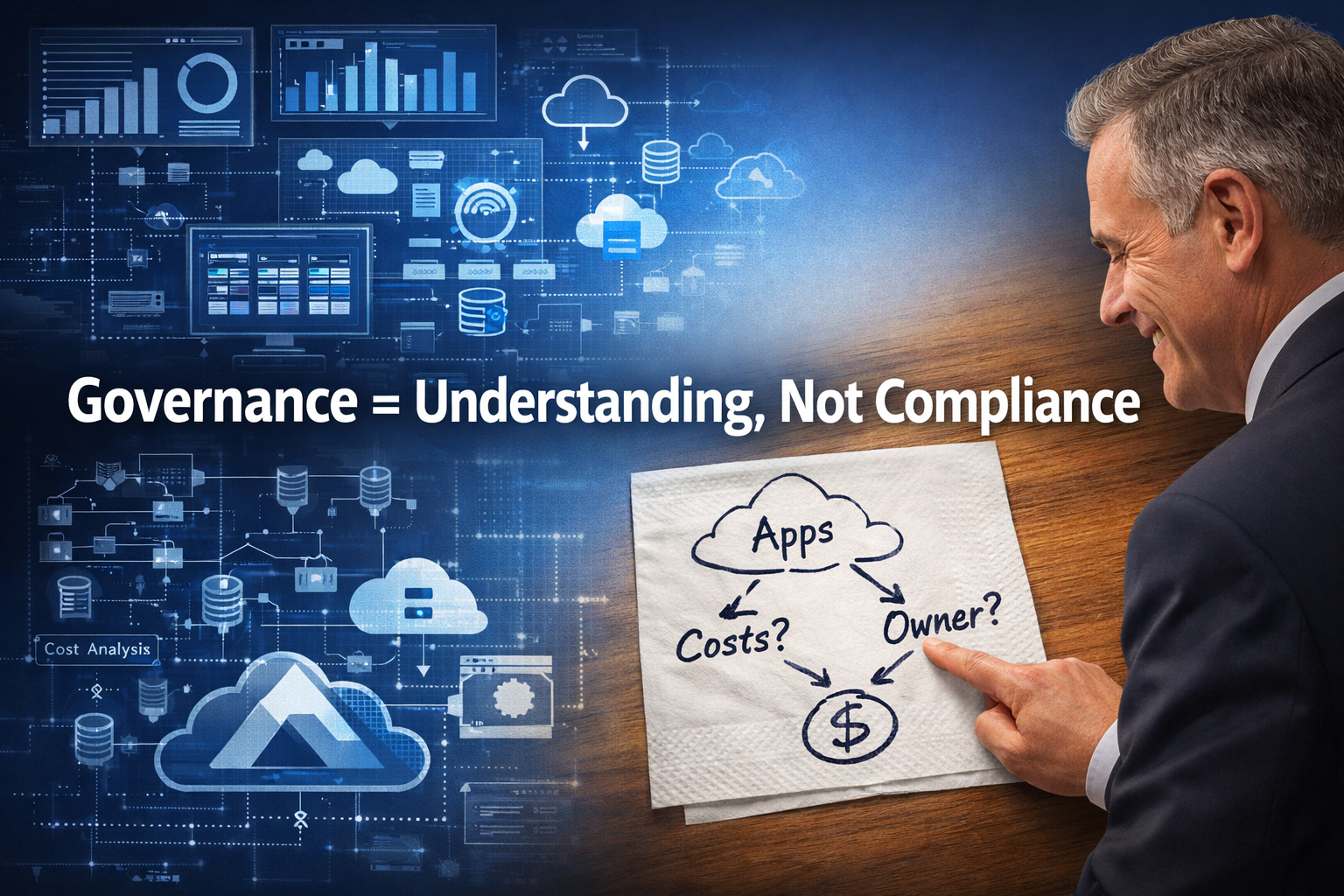
The Napkin Test: Why 90% of Azure Governance Fails at the Executive Level
2025-12-16 · ~13 min read
Azure Policy enforces rules. Landing Zones provide structure. Tags enable reporting. But if you can't explain your Azure bill on a napkin, none of it matters. Here's why governance fails—and what defensibility actually requires.
The CFO walks into your office with a printout.
"Why did Azure cost $2.3M this quarter?"
You have:
- Azure Policy enforcing compliance
- Landing Zone with perfect architecture
- Tags on every resource
- Workbooks showing metrics
- Dashboards with pretty graphs
But you can't answer the question.
Not in 30 seconds.
Not on a whiteboard.
Not on a napkin.
This is the governance failure no one talks about.
The Problem: Tools Enforce Rules, Not Understanding
This guide is part of our Azure Governance hub covering the gap between compliance and defensibility in enterprise cloud environments.
Every enterprise Azure environment has the same stack:
Layer 1: Azure Policy
- SKU restrictions
- Required tags
- Security baselines
- Audit findings
Layer 2: Landing Zones
- Management groups
- Subscription design
- Network topology
- Identity hierarchy
Layer 3: Tagging Standards
- CostCenter
- Owner
- Environment
- Application
Layer 4: Reporting Tools
- Azure Monitor Workbooks
- Power BI dashboards
- Cost Management exports
- Custom queries
This stack gives you:
- ✅ Compliance
- ✅ Security controls
- ✅ Resource inventory
- ✅ Cost visibility
But it doesn't give you:
- ❌ Defensibility
And there's a critical difference.
Compliance ≠ Defensibility
Compliance means:
"Our resources follow the rules we wrote."
Defensibility means:
"I can explain why this costs what it costs—and justify it to someone who doesn't trust me."
Example:
Compliant Azure bill:
"All resources are tagged correctly. Policy enforced. Landing Zone followed. Here's the report."
Defensible Azure bill:
"Application X costs $180K/month because it serves 2,400 users across 12 regions with 99.95% SLA requirements. Storage is $40K due to 7-year retention for SOX compliance. Network is $25K for dual ExpressRoute. Compute scales between $95K-$140K based on usage. Here's the breakdown by business capability."
The first answer is compliant.
The second answer is defensible.
And most Azure environments can only produce the first one.
The Napkin Test
Can you explain your Azure costs on a napkin?
Not "here's a dashboard."
Not "let me pull a report."
Right now. On a napkin. In 60 seconds.
Try this exercise:
- Draw three boxes: Production, Staging, Development
- Write the monthly cost in each box
- Break Production into: Apps, Data, Network, Security
- For the largest app: What does it do? How many users? What's the SLA?
If you can't do this without looking anything up:
Your governance isn't working.
It doesn't matter how good your policies are.
It doesn't matter how clean your Landing Zone is.
It doesn't matter how consistent your tags are.
If the person responsible can't explain it simply, it's not governed—it's just compliant.
Why Tools Fail the Napkin Test
1. Tags Report Facts, Not Meaning
Your tags say:
- CostCenter: 4200
- Environment: Production
- Owner: John Smith
- Application: CustomerPortal
Great. Now explain:
- Why does CustomerPortal cost $340K/month?
- Is that reasonable?
- What would happen if we cut it by 30%?
- Which business capability would we lose?
Tags don't answer these questions.
They just group resources.
This is the same pattern I described in Azure Policy Doesn't Fix Bad Architecture—tools enforce structure, but structure alone doesn't create understanding. Policy can enforce that resources have a CostCenter tag, but it can't enforce that the CostCenter actually means something useful.
2. Landing Zones Organize, They Don't Explain
Your Landing Zone has:
- Hub-and-spoke network
- Management groups per business unit
- Subscriptions per environment
- Policies per compliance domain
Beautiful architecture.
Now explain:
- Why did Subscription A's costs go up 40% last month?
- Which business decisions drove that?
- What trade-offs were made?
- What's the ROI?
Your Landing Zone can't answer these questions either.
It provides structure. But structure without narrative isn't governance—it's just organized chaos.
As we saw in Azure Landing Zone Reality Check, Landing Zones drift without continuous operational context. The same applies to cost understanding—without continuous narrative, the architecture becomes meaningless. You can have perfect hub-and-spoke topology but still can't explain why Subscription A costs 3x more than Subscription B.
3. Policy Audits the Past, Not the Future
Azure Policy tells you:
- 23 VMs missing required tags
- 12 storage accounts without encryption
- 7 NSGs with overly permissive rules
- 156 resources non-compliant with baseline
That's useful for compliance.
But it doesn't tell you:
- Should we have these resources at all?
- Are they solving actual business problems?
- What happens if we decommission them?
- How do costs map to outcomes?
Policy enforces rules you already wrote.
It doesn't tell you if the rules make sense.
4. Dashboards Show Data, Not Decisions
Your Power BI dashboard has:
- Monthly spend trends
- Top 10 costliest resources
- Budget vs actual
- Forecasted overruns
Leadership asks: "Why did costs go up?"
You show them the dashboard.
They ask: "But why?"
You click through more visuals.
They ask: "What business decision caused this?"
Your dashboard has no answer.
Because dashboards show what happened.
They don't explain why it happened or whether it should have happened.
What Defensibility Actually Requires
Real governance—the kind that survives CFO questions, board meetings, and audits—requires narratives, not just compliance.
Here's what defensible Azure costs look like:
1. Business Context per Dollar
Not defensible:
"Application X costs $180K/month."
Defensible:
"Application X costs $180K/month. It serves 2,400 active users in Claims Processing, which generates $4.2M in annual revenue. The $180K breaks down as: $120K compute (scaled for peak load), $40K storage (7-year retention, SOX), $20K network (dual ExpressRoute for 99.95% SLA). Removing ExpressRoute would save $20K/month but violate our uptime commitment to customers."
2. Decision History
Not defensible:
"We deployed these VMs in Q2."
Defensible:
"We deployed these VMs in Q2 during the CustomerPortal v3 launch. Initial sizing was conservative (32 vCPU) but we scaled to 64 vCPU in July when usage hit 85% sustained. We considered autoscaling but peak load duration (4 hours/day) made fixed sizing more cost-effective. Cost increased $18K/month but prevented three outages that would have cost $200K+ in SLA penalties."
3. Trade-Off Awareness
Not defensible:
"Storage costs $45K/month."
Defensible:
"Storage costs $45K/month. We chose Premium SSD ($30K) over Standard HDD ($8K) because database IOPS requirements (15,000) can't be met with Standard. The extra $22K/month prevents query timeouts that caused 12 customer escalations in Q1. Alternative: Move to Managed Disk with caching—projected savings $8K/month, testing scheduled for Q1."
4. Owner Accountability
Not defensible:
"Owner: John Smith"
Defensible:
"Owner: John Smith (Director, Claims Processing). John approved the architecture in May, signed off on Q3 scaling in July, and requested the ExpressRoute upgrade in September. He's accountable for keeping costs under $200K/month and currently tracking at $186K. He reviews costs weekly and has flagged three optimization opportunities for Q1."
The Uncomfortable Truth About Azure Governance
Most enterprises confuse:
- Control with governance
- Compliance with defensibility
- Reporting with understanding
You can have 100% policy compliance and still have indefensible costs.
You can have perfect Landing Zones and still can't explain your bill.
You can have comprehensive tagging and still fail the napkin test.
Because tools enforce rules. They don't create meaning.
And governance without meaning is just expensive compliance theater.
What Changes When You Require Defensibility
When you shift from "compliance" to "defensibility," everything changes:
Before: Tag Governance
"All resources must have CostCenter tag."
Result: 98% compliance, but:
- CostCenter 4200 has $1.2M in costs nobody can explain
- Three subscriptions have identical tagging but wildly different costs
- Tags are accurate but meaningless
After: Defensibility Governance
"All resources must have business justification that survives CFO scrutiny."
Result: Every cost has:
- Business context (what it does)
- Decision history (why it exists)
- Trade-off awareness (what we're choosing)
- Owner accountability (who's responsible)
Before: Landing Zone Standards
"Follow hub-and-spoke. Use management groups. Apply policies."
Result: Beautiful architecture, but:
- Can't explain why Subscription A costs 3x more than Subscription B
- Network design is perfect but nobody knows what goes through it
- Policies enforced but nobody remembers why we wrote them
After: Defensibility Standards
"Every architectural decision must be explainable to non-technical stakeholders."
Result: Every design choice has:
- Business rationale (why this architecture)
- Cost implications (what it costs and why)
- Trade-off analysis (what we gave up)
- Success criteria (how we know it's working)
The Missing Layer: Cost Defensibility Scoring
This is the gap between what tools provide and what governance requires.
You need a layer that asks:
For every resource:
- What business capability does this support?
- Who's accountable for its cost?
- What decision led to its current size/SKU?
- What trade-offs were considered?
- How does cost map to business value?
For every subscription:
- What's the business purpose?
- Why does it cost what it costs?
- What would break if we cut costs 20%?
- Who reviews this monthly?
For the entire environment:
- Can we explain 80% of costs in business terms?
- Do cost trends align with business activity?
- Are architectural decisions documented and justified?
- Can we defend this bill to the CFO right now?
This isn't something Azure Policy can enforce.
It's not something Landing Zones provide.
It's not something tags capture.
This is the operational discipline that makes governance real.
The Napkin Test for Your Environment
Try this with your Azure environment right now:
Step 1: Pick your three largest costs
Don't look anything up. From memory:
- What are your top 3 cost centers?
- Roughly how much per month?
Step 2: Explain them in business terms
For each one:
- What does it do?
- Why does it cost that much?
- What trade-offs were made?
- Who's accountable?
Step 3: Identify your gaps
Where did you have to say:
- "I'd need to check..."
- "I'm not sure why..."
- "Let me pull a report..."
- "I think it's for..."
Those gaps are where your governance is failing.
Not compliance.
Not policy.
Not Landing Zones.
Not tags.
Governance.
🔍 Validation: Do You Fail the Napkin Test?
Run this KQL query to instantly find resources that have zero business context (meaning you can't explain them).
// Find resources that fail the Napkin Test (Missing Business Context)
Resources
| where tags !has "CostCenter" or tags !has "Application"
| summarize UnexplainableCost=count() by subscriptionId
| render piechart with (title="Resources You Can't Explain on a Napkin")
If this query returns results, you have an Explainability Gap.
What This Means for Enterprise Azure
If you manage Azure at enterprise scale, you've felt this gap:
You present a dashboard.
Leadership asks "why."
You show policy compliance.
They ask "but why does it cost this much."
You show tagging reports.
They ask "what would happen if we cut this."
And you realize:
All your tools report what.
None of them explain why or whether we should.
This is why:
- Finance doesn't trust IT's Azure bills
- Leadership questions every invoice
- Auditors find "no control deficiencies" but everyone knows costs are out of control
- You can't make confident recommendations about what to cut
This is the same organizational failure pattern that causes Landing Zone drift—not technical problems, but the gap between what tools provide and what governance requires.
Not because you lack data.
Because you lack defensibility.
Building Toward Defensibility
You can't fix this overnight.
But you can start by asking better questions:
Every time you deploy something:
- What business capability does this support?
- Who's accountable for this cost?
- What trade-offs did we consider?
- How will we know if this was the right decision?
Every time costs increase:
- What business change drove this?
- Was this intentional or drift?
- Who approved this?
- What's the ROI?
Every time you review your environment:
- Can I explain 80% of costs without looking anything up?
- Would this explanation satisfy the CFO?
- If I had to cut 20%, what would I cut and why?
- Who owns each major cost center?
These questions don't require new tools.
They require new discipline.
They require treating governance as understanding, not just compliance.
The Hard Truth
You can't govern what you can't explain.
And if you can't explain it on a napkin—in 60 seconds, in business terms, to someone who doesn't trust you—you don't understand it well enough to govern it.
Azure Policy will keep enforcing your rules.
Landing Zones will keep organizing your resources.
Tags will keep grouping your costs.
But until you can pass the napkin test, none of that is governance.
It's just expensive infrastructure with extra steps.
What's Next
The three posts that form this governance arc:
- Azure Policy Doesn't Fix Bad Architecture - Why enforcement alone fails
- Azure Landing Zone Reality Check - Why structure alone drifts
- This post - Why compliance alone isn't governance
Together, they explain the gap between what tools provide and what enterprise governance requires.
The next question is: What does a defensible Azure environment actually look like?
That's a question worth exploring.
Related Posts
More governance reality checks:
- Azure Policy Doesn't Fix Bad Architecture
- Azure Landing Zone Reality Check
- Tag Governance: 247 Variations of "Production"
- Azure Cost Reporting for the Boardroom
🛑 Who Owns Your Azure Environment?
If you can't explain who owns a resource on a napkin, you can't govern it.
Download the Azure RACI Matrix to map every subscription to a clear business owner today.
Azure Admin Starter Kit (Free Download)
Get my KQL cheat sheet, 50 Windows + 50 Linux commands, and an Azure RACI template in one free bundle.
Azure Admin Starter Kit (Free Download)
Get my KQL cheat sheet, 50 Windows + 50 Linux commands, and an Azure RACI template in one free bundle.
Get the Starter Kit →💰 Stop Guessing at Azure Costs
Get the Azure FinOps Framework with cost allocation templates, tag governance policies, and showback dashboards that finance actually understands.
Download FinOps FrameworkExcel template • KQL queries included • No email required