
Azure Policy Doesn't Fix Bad Architecture (Microsoft Pretends It Does)
2025-12-15 · ~9 min read
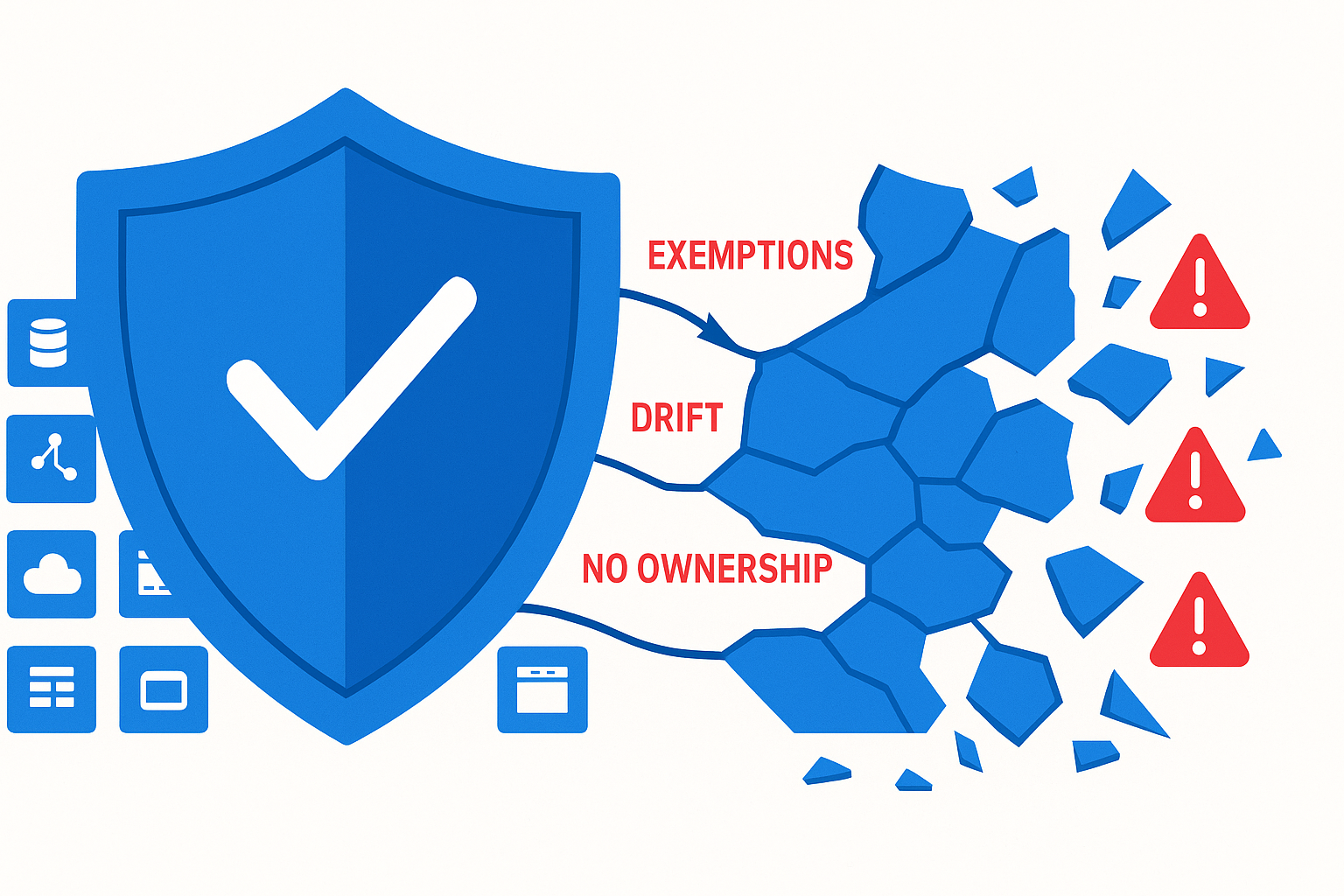
Azure Policy enforces rules at scale - but it can't tell you if your subscriptions make sense, if your tags are lies, or why your $2M Azure bill is indefensible. Policy is a guardrail, not a steering wheel.
This guide is part of our Azure Governance hub covering policy frameworks, compliance enforcement, and the organizational reality that breaks theoretical governance at scale.
The Uncomfortable Truth
Every Azure architect presentation includes a slide about Azure Policy.
The slide shows:
- ✅ Enforce SKU restrictions
- ✅ Require tags at deployment
- ✅ Block public endpoints
- ✅ Audit compliance across subscriptions
The slide is correct.
What the slide doesn't show:
- Your finance team still can't explain the Azure bill
- Nobody knows which resources belong to which applications
- Tag compliance is 97% but cost attribution is still broken
- You have 100% policy compliance and completely indefensible costs
Policy enforces rules — it does not create meaning.
After managing 31,000 Azure resources across 44 subscriptions at a regional bank, I've watched this pattern repeat:
- Architecture team deploys comprehensive Azure Policy
- Compliance dashboards turn green
- Finance asks "why did Engineering spend $47K last month?"
- Nobody can answer
The policies worked. The governance failed.
What Azure Policy Actually Does Well
Let's be fair - Azure Policy is excellent at specific technical enforcement:
SKU Restrictions
Prevent F-series VMs in production subscriptions. Block Premium storage in dev environments. Enforce Standard Load Balancers only.
This works. Policy can see SKU names and deny deployments.
Location Controls
Require all resources in East US 2. Block Azure China regions. Enforce regional pairing for disaster recovery.
This works. Policy understands location metadata.
Security Baselines
Require encryption at rest. Block public blob containers. Enforce private endpoints for SQL databases.
This works. Policy can audit security configurations.
Tag Enforcement
Require CostCenter tag at deployment. Mandate Environment classification. Block resources without Owner tags.
This works... technically.
Here's where it gets complicated.
Where Azure Policy Silently Fails
Azure Policy can enforce presence. It cannot enforce truth.
1. Policy Cannot Infer Application Boundaries
You have a subscription with:
- 12 VMs
- 3 SQL databases
- 5 storage accounts
- 2 App Service plans
Question: How many applications is this?
Policy's answer: ¯\(ツ)/¯
Policy sees 22 resources with required tags. All compliant. But it has no concept of "this VM and that database form Application X."
The problem: Cost allocation requires application context. Policy provides resource-level compliance without application-level meaning.
2. Policy Cannot Resolve Shared Services
Your Log Analytics workspace serves 8 applications. Cost: $4,200/month.
Question: How much does each application owe?
Policy's answer: Silence.
You can require an ApplicationName tag on the workspace. But policy can't follow the diagnostic settings to determine which VMs, databases, and app services are actually sending logs.
The result: Shared services become cost black holes that break chargeback models.
3. Policy Assumes Tags Are Truth
Policy can verify:
- ✅ Tag exists
- ✅ Tag matches allowed values
- ✅ Tag was present at deployment
Policy cannot verify:
- ⌠Tag is accurate
- ⌠Tag reflects current reality
- ⌠Tag matches what Finance expects
Real example from our environment:
Resource: vm-prod-api-server-01
CostCenter tag: "1234-Engineering" ✅ (Policy compliant)
Actual cost center: "5678-Marketing" (API serves marketing site)
The tag passed policy validation at deployment. Six months later, nobody remembers the server was repurposed. Finance charges Engineering. Marketing's actual costs are invisible.
Policy enforced compliance. Reality diverged anyway.
4. Policy Cannot Tell You If Your Subscriptions Make Sense
You have a subscription called "Shared-Services-Prod" with:
- Domain controllers (Infrastructure team)
- File shares (Collaboration team)
- Jump boxes (Security team)
- Monitoring agents (Operations team)
Azure Policy sees 100% compliant resources with perfect tagging.
Finance sees: A $23K/month subscription bill with no clear business owner.
Who gets charged? How much should each team pay? What happens when Infrastructure wants to optimize costs but Security says "don't touch our jump boxes"?
Policy cannot answer these questions because policy operates at the resource level, not the organizational level.
The Subscription Problem (Where Architects Get It Wrong)
Here's the architecture mistake that breaks FinOps:
Subscriptions are security boundaries first, billing boundaries second.
Microsoft's documentation is clear about this - subscriptions exist primarily for:
- RBAC isolation
- Policy scope
- Compliance boundaries
- Azure AD tenant association
But in enterprise Azure:
- CFOs see subscriptions as cost centers
- Finance expects subscription = budget owner
- Chargeback models assume subscription = team
Reality: Multiple business units share subscriptions because security architecture demands it.
When this happens:
- Cost attribution depends entirely on tags
- Tags decay over time
- Shared services become unallocatable
- Finance loses trust in Azure bills
Why This Matters For Policy
You can enforce perfect tag compliance and still have an indefensible cost model.
Example from our Synovus-Pinnacle merger:
- 21 Active Directory domains
- Hybrid networking requires centralized connectivity subscription
- ExpressRoute costs: $8,400/month
- VMware Bridge connections: $3,200/month
Question: Which business unit pays for the ExpressRoute circuit serving all 21 domains?
Azure Policy: ✅ All resources tagged correctly!
Finance: "We need you to allocate this to a cost center."
Reality: There is no single cost center. This is shared infrastructure.
Policy enforcement succeeded. Cost defensibility failed.
Why Microsoft Doesn't Talk About This
Microsoft can't prescribe organizational structure.
Think about it:
- Should you use one subscription per application?
- Or one subscription per environment?
- Or one subscription per business unit?
- Or hub-and-spoke with shared services?
The answer is: It depends on your org chart, security requirements, compliance mandates, M&A history, and political realities.
Microsoft can't tell Bank of America to reorganize their IT department.
So instead, Microsoft provides:
- ✅ Azure Policy (enforcement)
- ✅ Management Groups (hierarchy)
- ✅ Cost Management (reporting)
- ✅ Resource Graph (querying)
What Microsoft doesn't provide: A model for determining if your structure makes sense.
Microsoft gives you enforcement tools, not accountability models.
This isn't a criticism - it's the nature of platform products. Azure has to work for a 10-person startup and a 100,000-person enterprise.
But it means you have to figure out the accountability model. Policy won't do it for you.
The Missing Layer
Here's what actually matters for FinOps:
Not "are my resources compliant?"
But "can I explain this Azure bill?"
Specifically:
- Can I trace every resource to an application?
- Can I map every application to a business owner?
- Can I allocate shared services defensibly?
- Can I answer Finance's questions without 4 hours of KQL queries?
Call it cost defensibility.
You need to measure:
- Tag accuracy (not just presence)
- Application boundaries (not just resource compliance)
- Ownership clarity (not just RBAC assignments)
- Allocation logic (not just budget alerts)
Policy gives you enforcement. You still need defensibility.
What Defensibility Looks Like
On a napkin, you should be able to draw:
1. Which subscriptions exist
2. Which applications live in each subscription
3. Who owns each application
4. How shared services are allocated
If you can't draw this and have it match your Azure environment, policy compliance is just theater.
This is exactly the governance gap I explore in You Can't Govern What You Can't Explain on a Napkin—tools enforce compliance, but defensibility requires understanding. Until you can explain your Azure bill in 60 seconds to someone who doesn't trust you, Policy is just paperwork.
The Real Governance Stack
If I were building Azure governance from scratch today:
Layer 1: Azure Policy (Baseline)
- Enforce security baselines
- Block obvious misconfigurations
- Require technical compliance
Layer 2: Tag Governance (Accuracy)
- Not just "tag exists"
- But "tag is true"
- Validation against CMDB
- Decay detection
Layer 3: Application Mapping (Context)
- Define application boundaries
- Map resources to apps
- Track shared services
- Measure fragmentation
Layer 4: Ownership Model (Accountability)
- Business owner per application
- Cost allocation rules
- Chargeback logic
- Exception handling
Most enterprises have Layer 1. Almost nobody has Layers 3-4.
And Layers 3-4 are where FinOps actually works.
What This Means For You
If you're responsible for Azure governance:
Azure Policy will not save you from bad architecture.
Policy can enforce that every VM has a CostCenter tag. Policy cannot tell you if 37 different cost centers in one subscription makes sense.
Policy can require Environment=Production tags. Policy cannot tell you why you have 14 different production subscriptions.
Policy can block public endpoints. Policy cannot explain why your finance team doesn't trust your cost allocation model.
The work of governance is organizational, not technical.
Yes, deploy Azure Policy. Enforce baselines. Audit compliance.
But don't confuse policy compliance with cost defensibility.
If you can't draw your Azure environment on a napkin and explain who pays for what, all the Azure Policy in the world won't fix your FinOps problem.
The Bottom Line
Azure Policy is a guardrail, not a steering wheel.
Guardrails keep you on the road. But if you're driving in circles because nobody knows where you're going, the guardrails just enforce the chaos.
Policy enforces rules. Architecture creates meaning.
Get the architecture right first. Then enforce it with policy.
Not the other way around.
🛑 Who Owns the Policy?
Policy fails when no one owns the architecture behind it.
Download the Azure RACI Matrix to map every policy scope to a specific owner.
Azure Admin Starter Kit (Free Download)
Get my KQL cheat sheet, 50 Windows + 50 Linux commands, and an Azure RACI template in one free bundle.
Get the Starter Kit →💰 Stop Guessing at Azure Costs
Get the Azure FinOps Framework with cost allocation templates, tag governance policies, and showback dashboards that finance actually understands.
Download FinOps FrameworkExcel template • KQL queries included • No email required