
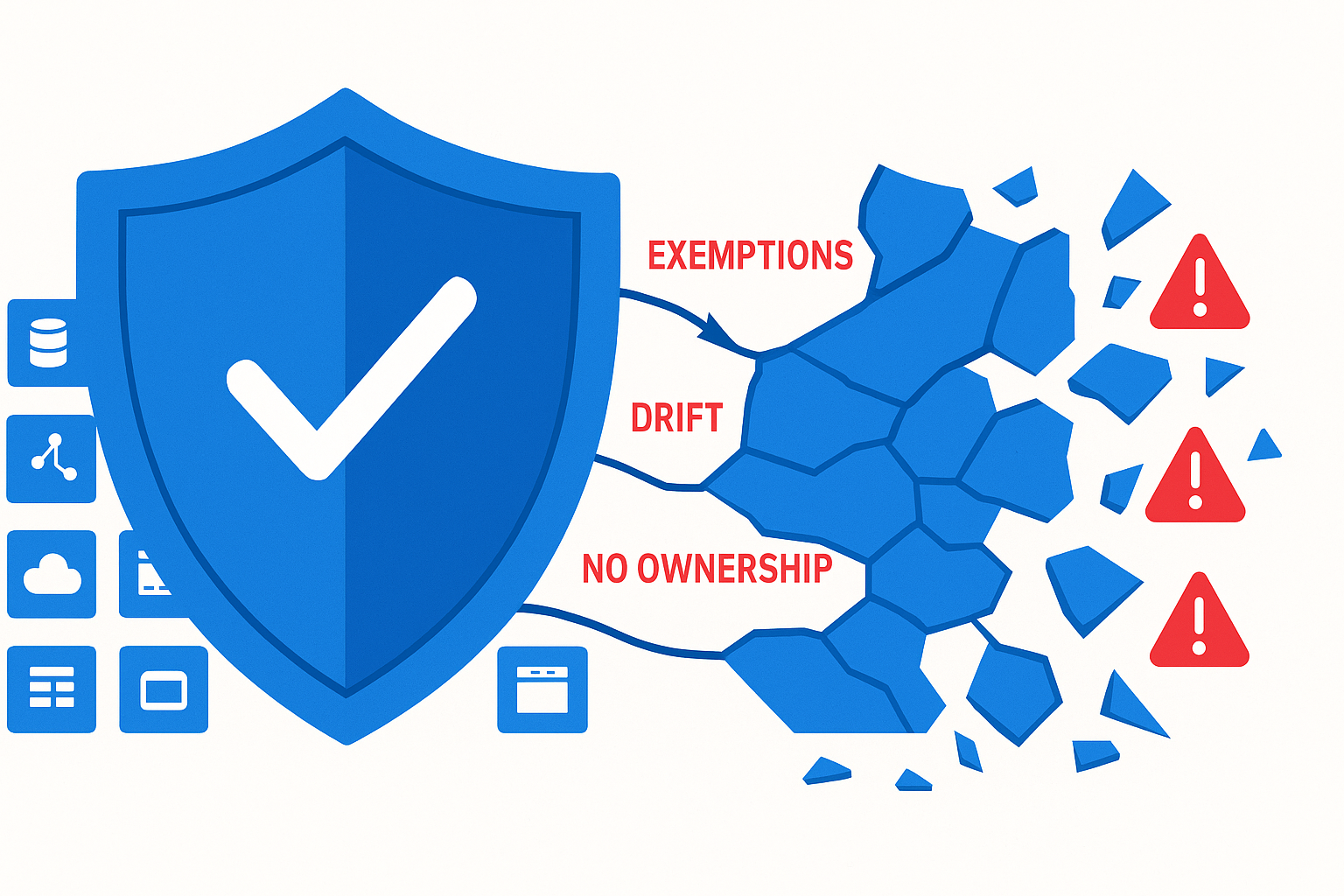
Azure Policy Reality Check: Why Your Guardrails Fail After 30 Days
2025-12-20 · ~12 min read
Azure Policy is powerful on paper, but in enterprise environments the guardrails collapse almost immediately. Here's why your policies stop working and what it takes to build a policy framework that survives production.
Every Azure architecture deck includes a slide about Azure Policy.
This guide is part of our AI-Assisted Azure Operations hub exploring how AI tools transform cloud administration and productivity workflows.
It looks clean.
It looks enforceable.
It looks automated.
It looks like a governance dream.
You define the policies.
You assign them to management groups.
You monitor the compliance dashboard.
You pat yourself on the back.
And then reality arrives.
Within 30 days, your Azure Policy guardrail is no longer aligned with your Azure environment.
This article explains why, and what it takes to build policy governance that isn't just technically correct — but operationally survivable.
The Hidden Truth About Azure Policy
I've managed Azure Policy across 40+ subscriptions, 30,000+ resources, multiple Landing Zones, and more policy exemptions than I care to admit.
Azure Policy does not fail because:
- It lacks features
- It lacks depth
- It lacks control
- It lacks enforcement
Azure Policy fails because enterprises do not operationalize it.
Policies are created, but not:
- Owned
- Reviewed
- Versioned
- Expired
- Justified
- Automated
- Monitored with context
The result?
A beautiful governance framework that decays the moment real teams deploy real workloads.
Let's walk through the lifecycle of policy drift.
1. Policies Start as "Audit Only" and Never Graduate
Every organization begins cautiously:
- "Let's audit first."
- "We don't want to block deployments yet."
- "We'll enforce in Phase 2."
But Phase 2 never comes.
Real example: We deployed a policy requiring encryption at rest for all storage accounts. Started as "audit only" with a 90-day timeline to enforce.
- Week 2: 156 non-compliant resources detected
- Week 4: Teams promised to fix "after the migration"
- Week 8: Leadership asked to delay enforcement
- Week 12: Policy still in audit mode
- Month 6: Policy disabled entirely because "it was causing confusion"
Because:
- App teams complain
- Leadership wants velocity
- Architects get pulled into new projects
- Nobody wants to "own" blocking policies
- Exceptions pile up
- Compliance becomes a suggestion, not a requirement
Audit-only policies become permanent — and governance dies quietly.
2. Policy Exemptions Become the Wild West
Policy exemptions are a critical part of governance.
But in most organizations:
- Exemptions are too broad
- Exemptions have no expiration
- Exemptions are granted at the wrong scope
- Nobody reviews exemptions
- Exemptions are treated as approvals, not deviations
Real numbers from my environment:
We deployed a policy requiring specific VM SKUs (to control costs and licensing).
- Day 7: 12 exemption requests
- Day 14: 23 exemption requests
- Day 21: 47 exemption requests
- Day 30: Policy exempted at management group level
The policy existed, but nobody followed it.
Within weeks:
Your governance structure becomes an exemption-driven environment, not a policy-driven environment.
This is how well-designed Landing Zones fall apart.
3. Azure Policies Are Assigned Without an Ownership Model
A functional policy requires answers to three questions:
- Who owns this policy?
- Who approves exemptions?
- Who updates the policy when Azure changes?
Most organizations answer:
- "Security wrote it."
- "Cloud team assigned it."
- "Operations is supposed to enforce it."
- "We'll figure out exceptions later."
Real scenario I've lived:
Policy: "All VMs must use Managed Identities"
- Security team: "We created the policy"
- Cloud team: "We assigned it to subscriptions"
- App team: "It's blocking our deployment"
- Operations: "We don't know how to fix this"
- Leadership: "Who approved this policy?"
Answer: Nobody owned it. Policy was disabled within 48 hours.
No owner = no governance.
4. Architecture Changes, but Policies Don't
Azure evolves.
Workloads evolve.
Your environment evolves.
But your policies remain frozen in time.
Real examples from my environment:
Policy Drift Example 1: VM SKU Policy
- Policy enforced Standard_D4s_v3 VMs (cost control)
- Azure deprecated the SKU
- Policy started blocking ALL deployments
- Nobody updated the policy for 3 months
- Teams deployed VMs outside policy scope to work around it
Policy Drift Example 2: Tagging Requirements
- Original policy: Require "CostCenter" tag
- Finance changed to "AppID" model
- Policy still enforced old tag
- 40% of resources non-compliant
- Finance couldn't track costs properly
Policy Drift Example 3: Network Security
- Policy denied public IP creation
- New hub-and-spoke model needed NAT Gateway with public IP
- Infrastructure team couldn't deploy
- Emergency exemption created at subscription level
- Defeated the entire security control
Policies that never evolve become policies that quietly break your platform.
5. Policy Effects Are Misunderstood — and Misused
Azure Policy is not "yes/no" enforcement.
It has nuance:
- audit - Log non-compliance, don't block
- deny - Block resource creation
- denyAction - Block specific operations (delete, modify)
- modify - Auto-fix non-compliant resources
- deployIfNotExists - Deploy resources if missing
- append - Add properties to resources
Most enterprises misuse effects:
Under-enforcement:
- Everything is "audit" (nothing blocked)
- Teams ignore compliance dashboard
- Governance is theater
Over-enforcement:
- Everything is "deny" (everything blocked)
- App teams can't deploy
- Emergency exemptions everywhere
- Policy disabled globally
Misused DINE:
- DeployIfNotExists creates duplicate resources
- Runs thousands of times unnecessarily
- Operations team overwhelmed by automation
- Policy disabled to stop the noise
Real example: We used deployIfNotExists to ensure Azure Monitor Agent on all VMs.
Result:
- 500 VMs × daily evaluation = 15,000 policy evaluations/month
- Agent re-installed on every evaluation
- VM reboots during business hours
- Operations team received 200+ alerts/day
- Policy disabled after 2 weeks
Without policy engineering discipline, your guardrails become operational landmines.
6. The Compliance Dashboard Lies by Omission
Azure Policy's compliance dashboard is helpful — but incomplete.
It shows you:
- Compliant resources: ✅
- Non-compliant resources: ❌
- Exempted resources: ⚠️
It does NOT tell you:
- Which workloads are drifting faster than others
- Which management groups require redesign
- Which exempted resources pose actual risk
- Whether your Landing Zone itself is misaligned
- Whether your operations team is overwhelmed
- Whether a "passing" resource is compliant for the wrong reason
Real scenario:
Compliance dashboard: "95% compliant"
Reality check via KQL:
PolicyResources
| where type == "microsoft.policyinsights/policystates"
| extend complianceState = tostring(properties.complianceState)
| where complianceState == "Compliant"
| extend resourceType = tostring(properties.resourceType)
| where resourceType == "Microsoft.Compute/virtualMachines"
// Filter to resources that are "compliant" but exempted
| join kind=inner (
    PolicyResources
    | where type == "microsoft.authorization/policyexemptions"
) on $left.properties.resourceId == $right.properties.policyAssignmentId
| summarize ExemptedButCompliant = count()
Result: 300 VMs showing as "compliant" only because they were exempted, not because they met the policy.
Compliance ≠ Governance.
It's a signal — not the truth.
7. No Policy Review Cadence = Guaranteed Drift
Without a review practice, policies become obsolete.
What happens without reviews:
- Policies created in 2023 still reference deprecated Azure services
- Exemptions from 18 months ago still active (nobody remembers why)
- Policy effects conflict with new Landing Zone design
- Compliance dashboard ignored because "it's always red"
A real policy program includes:
- Monthly: Exemption review and expiration enforcement
- Quarterly: Policy effectiveness review
- Annually: Complete policy architecture review
- Continuous: Policy version control and change management
Real workflow that works:
Week 1 of each month:
├── Export all policy exemptions
├── Identify exemptions >90 days old
├── Email resource owners for justification
├── Remove unjustified exemptions
└── Report to governance team

Quarter-end:
├── Review policy compliance trends
├── Identify policies with >50% exemption rate
├── Evaluate policy effectiveness
├── Propose policy updates or retirement
└── Leadership review and approval
Governance is not something you "do once."
It is something you maintain forever.
The Real Reason Azure Policies Fail
Policies don't fail because you wrote them incorrectly.
Policies fail because you tried to govern a dynamic cloud environment using a static process.
Azure Policy is not a technical tool — it is an organizational discipline.
If you treat it like a checkbox, your guardrails will collapse within weeks.
If you treat it like a living system, you can build an environment that enforces itself.
What a Surviving Policy Framework Looks Like
Here's what organizations that get it right always include:
1. Policy Ownership Model
Every policy must have a designated owner with:
- Decision authority
- Exemption authority
- Update responsibility
Example ownership matrix:
| Policy | Owner | Exemption Approver | Update Cadence |
|---|---|---|---|
| VM SKU enforcement | Cloud Arch Team | VP Infrastructure | Quarterly |
| Encryption at rest | Security Team | CISO | Semi-annual |
| Tag governance | FinOps Team | CFO | Monthly |
| Network controls | Network Team | Director Security | Quarterly |
2. Expiring Exemptions
No exemption should last longer than:
- 30 days for critical security controls
- 90 days for operational exceptions
- 180 days for legacy migration workloads
Exemption workflow that works:
{
  "properties": {
    "policyAssignmentId": "/providers/Microsoft.Management/managementGroups/mg-prod/providers/Microsoft.Authorization/policyAssignments/enforce-encryption",
    "exemptionCategory": "Waiver",
    "expiresOn": "2026-03-15T00:00:00Z",
    "metadata": {
      "requestedBy": "john.doe@company.com",
      "approvedBy": "jane.smith@company.com",
      "justification": "Legacy app migration in progress, encryption enabled in Q2",
      "reviewDate": "2026-02-15",
      "ticketNumber": "INC123456"
    }
  }
}
Automated enforcement:
- ServiceNow integration for exemption requests
- Auto-expiration after 90 days
- Email notifications 14 days before expiration
- Auto-deletion if not renewed
3. Quarterly Policy Reviews
Not optional.
Not postponed.
Not "best effort."
A surviving governance program is a scheduled governance program.
Quarterly review checklist:
- Policy compliance trends (improving or degrading?)
- Exemption analysis (which policies need exemptions most?)
- Policy effectiveness (is it preventing the problem?)
- Azure service updates (deprecated features?)
- Incident correlation (did policy prevent or cause issues?)
4. Policy-as-Code Automation
Policies must be:
- Versioned in Git
- Reviewed via pull requests
- Automatically deployed via CI/CD
- Tested in lower environments
- Tracked like any other production code
Real implementation:
/azure-policies
├── /definitions
│   ├── enforce-encryption.json
│   ├── enforce-tags.json
│   └── deny-public-ips.json
├── /assignments
│   ├── prod-mg-assignments.json
│   └── dev-mg-assignments.json
├── /exemptions
│   ├── legacy-workload-exemptions.json
│   └── migration-exemptions.json
└── /pipelines
    ├── policy-deploy.yml
    └── policy-test.yml
GitHub + Bicep/Terraform + Azure DevOps = Policy governance that cannot drift.
5. Operational Feedback Loops
If your operations team cannot keep up with alerts, your policy needs to change.
If your app teams cannot deploy workloads, your policy needs to change.
Real feedback loop:
- Weekly operations sync: "What's blocking you?"
- Monthly policy adjustment based on ops feedback
- Quarterly app team survey: "What policies are painful?"
Governance without empathy always fails.
The Reality Check
Azure Policy does not enforce governance.
You enforce governance.
Azure provides the framework —
your organization provides the discipline.
If your Landing Zone drifted (read part 1),
If your tags collapsed,
If your compliance dashboard is ignored,
If your exemptions outnumber your compliant resources…
Azure Policy won't fix that.
But a living policy program will.
💡 Want the Complete Policy Governance Framework?
I've built a policy governance checklist that covers:
- Policy ownership matrix template
- Exemption workflow (with ServiceNow integration)
- Quarterly review checklist
- Policy-as-code repository structure
- Automated exemption expiration scripts
It's the same framework I use to manage policy governance across 30,000+ resources.
👉 Download the Azure Integration Assessment Framework (Includes policy governance section)
Related Posts
Part 1 of this series:
- Azure Landing Zone Reality Check: Why Most Enterprises Drift in 90 Days
More governance reality checks:
- Tag Governance: Why 247 Variations Collapse Cost Reports
- Cloud Migration Reality Check: 55-Question Assessment
- Azure Arc Ghost Registrations: 64% Don't Exist
Azure Admin Starter Kit (Free Download)
Get my KQL cheat sheet, 50 Windows + 50 Linux commands, and an Azure RACI template in one free bundle.
Get the Starter Kit →🚀 Azure Admin Starter Kit
Get the KQL cheat sheet, 50 Windows + 50 Linux commands, and Azure RACI template in one free bundle. Built from managing 44 subscriptions and 31,000+ resources.
Get the Starter Kit →Free download • No email required • Instant access